Monday, December 10, 2012

Blog 5

Wow, I have to say that I was a skeptical of the usefulness of this course when I started.  The experience I have had with my other secondary education courses has been less than stellar.  However, this class certainly sets the standard for how useful, positive and productive a teacher education course can be.  I am very happy to have taken this course because it was a similar subject to another secondary education course I took but I feel like this one has given me concrete ideas and methods that I can use while student teaching and in my career. 

To begin with, I have learned that I can and should incorporate some form of reading into every unit I teach.  I can remember reading out of the book as sort of a punishment in high school and I think that has to change with my classes because reading is an important skill for students to develop and use.  In order to help students do this, there are a few things I need to do with every reading lesson.  First, never turn the students loose on the text and just expect them to understand.  I need to do pre-reading activities such as previewing the text and making inferences about what it could mean to get the students thinking then have them actively read with during reading activities.  Lastly, the after reading is most critical to understanding and comprehending a text so I must have the students ask questions, annotate the text or do a graphic organizer, some activity that applies the text to a deeper level.  I want to have a wide variety of texts for students to read because when the text is interesting, students are likely to be more engaged in the reading.

Next, writing is a very important job skill and most students have had bad experiences with writing.  I will do my best to incorporate some form of level one writing into my classes every day.  This is very informal writing and could be anything from filling in guided notes to working on a bell or exit quiz.  The purpose of this writing is just to get students writing down thoughts and ideas and not to be judgmental.  In terms of level two and three writing, these are going to be done less often in my classroom, probably a couple of times a semester.  I really like the level two writing because it allows me to just focus on one or two characteristics and not have to give a lesson on all the characteristics I want to look for in the writing.  In addition, this is going to be the majority of writing students do in a job.  A writing prompt is key to helping students feel like the writing is important and not too restrictive.  Things like making the audience real, giving students a rubric, and keeping the topic broad enough that there can be multiple answers is critical when it comes to writing prompts. 

Third, I have a good understanding of what critical literacy is and what I can do to incorporate it into my classroom without being overly aggressive about it.  In another course I took, we discussed mainly just the philosophy of critical literacy and I never had a good idea of how to incorporate it.  Working with digital text is a great time to work critical literacy into the picture because you can have students question the text, question any biases or sources/lack of, and many digital texts are up to date on social issues that can be talked about.  Critical literacy needs to happen mainly on the part of the students though.  I liked learning about how to make a good discussion, which I think, can happen in many parts of agriculture such as conventional vs. organic, cloning, genetically modified organisms, climate change, and immigrant workers.  Each of these does not have a definite answer, which is important when having a true, honest discussion where students can come up with their own questions on the subject.  Critical literacy fits into many segments of other forms of instruction and I think it is my job as a teacher to teach students to question and not just pass things off as true because someone else said it.

Overall, this course has given me some very good ideas of how to improve the learning of my students.  Reading, writing, using digital texts, helping ELLs, asking students to critically analyze, all these skills will improve my teaching as well as my students experience and learning.  I liked the fact that Amy modeled the lessons for us because it is easy for me to recall those lessons and then adapt it to my content area.  I also know how certain types of activities or lessons should be run and how to get students to the ultimate goal of the activity.  The ball is now in my court.  I know that some of my lesson plans I have created need some work to do all these things I have said I need.  Additionally, I need to constantly remind myself not to use writing or reading something as a punishment because it is very easy to fall into the trap.  Literacy is my job just as much as it is the English teacher’s job.  I have to do my part to be sure students are learning as much as they can and are prepared for a job or continued education when they leave my classroom. 

Sunday, December 9, 2012

Self Selected Project B - Book Club Discussion


Book Club Discussion

Summary of Selected Books.

a.)  Ken Lym, Stephanie Whipple and I each read three different books that we felt could be interesting to students in our field of agriculture education.  I read the book Thinking In Pictures by Temple Grandin.  Dr. Temple Grandin is a world renowned animal science expert who happens to credit much of her success and skill to being autistic.  Thinking in Pictures is a book that discusses Grandin's views on autism, how autism has allowed her to develop her skills and how autism can be helped and encouraged in others. 

To begin with, Temple Grandin talks about how she see's differently than the majority of us.  She see's in pictures.  Even the words she hears are translated into pictures that run in movie format in her head.  This has enabled her to be a very visual thinker and run through possible animal handling facilities through her head before she even writes this down.  At the time the book was written, 1/3 of all cattle in the United States are handled in facilities that Grandin had designed.  I like the fact that this book has the references sited throughout and is not purely opinion based.  I also like the stories Grandin uses to illustrate her points.  Half way along the book, there are a series of pictures that show some of Temple Grandin's drawings and facilities which allow us to see what she is talking about.  The big issue I have with the book is that it is written between an instructional and frustration level for high school students.  There are quite a few scientific words in the text that would be difficult for students to read the book independently.  Additionally, the opinions of Grandin are not very applicable to the content area and therefore I would only have students read certain portions of the text.

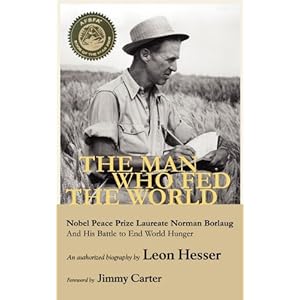
The Man Who Fed the World by Leon Hesser is a biography on the life and work of Norman Borlaug.  Borlaug is a Nobel Peace Prize winner and has been credited with saving the lives of over one million people.  Borlaug started out struggling with regular academic life, barely graduating high school and nearly not being admitted into college.  He attended a small school majoring in agriculture and developed a passion for the industry and helping to feed people.  Borlaug is known as, "The Father of the Green Revolution."  He earned the Nobel Prize from his work mainly in Mexico where he used beginning forms of biotechnology to create new forms of wheat that were more drought and heat tolerant.  I would like to use this book to teach a couple of concepts such as the history of biotechnology, highlighting a leader in agriculture and the essay contest, "Agriculture in a growing world." 

Equine Safety by Stephen Mackenzie is a safety manual that tells people from the advanced horseman to the beginner how to properly train and handle horses.  Mackenzie breaks down the book into 7 practical applications of how to interact safely with a horse.  The overall goal of working with horses is to be safe, always.  If not, you will get hurt.  The book includes quality pictures and diagrams to illustrate the training and safety.  I like the fact this book is very applicable and easily used by students.  The book does not have the resources sited and therefore it is difficult if a reader is looking into more information.  I also think the text is slightly outdated because the book was written in the 1990's and could be slightly more up to date.

b.)  Overall, I think all the books are applicable and readable by students.  I would use small portions of each text to teach from instead of assigning the whole book to be read.  Thinking in Pictures and Equine Safety could be used in one of my animal science classes when discussing animal handling and animal welfare.  Grandin and Borlaug are leaders in the agriculture industry and I would use their two books to teach more about them, their impact on agriculture and the ways they have succeeded past several obstacles. 

c.)  Reading does not just have to be from a text book.  This is one of the biggest shifts in thinking that occurred from this book club discussion.  I remember doing some reading in high school but it was all primarily off of the internet or small portions of a textbook.  I have seen that books, whether fiction or non-fiction, can be used to teach many concepts in agriculture.  It is a little difficult to find books in agriculture but when I do, I would like to use them as higher interest text's than a text book.  I would also like to encourage my students to read for their own personal pleasure.  I can do so by teaching from the books that are interesting to students and maintaining a  classroom library like I came up with to for students to peruse and read in their free time. 

d.)  In every unit I teach, I plan to incorporate reading to help teach or supplement part of a lesson.  I would like to find a list of texts that are interesting to students, easily read and can teach multiple concepts.  Some ways I could  do this is by reading portions of the text to students and having them analyze the portion, selecting parts of the text for individual reading and also grabbing excerpts from books that students have to look deeper into to understand the meaning of the book.  Mixing some of these high interesting books with text books should make students a little more willing to read and help them gain interest in reading for their own interest or pleasure.  I know that I cannot make my students read but by incorporating this into the classroom on a regular basis is a good way to increase the reading done by students and hopefully find something that all students could be interested in.  

Thursday, November 1, 2012

Scribbles and drafts (affective dimensions of writing)

I can remember in elementary school having to write probably 4 or more drafts of a paper in order to finally get it to the point that I could turn it into my teacher for final grading.  This frustrated me like no other!  Why in the world was I punished because I either had bad handwriting or I scribbled something out on my paper and then had to rewrite it?  Writing came easy to me.  Yet when it came to writing, especially handwriting, a polished copy of a paper or story it took me forever to get it right. 

I never had much problems with motivation to write throughout school.  Like I said, it came pretty easily.  I had a robust vocabulary, could spell pretty well (3rd grade Wells Elementary Spelling Bee Champ) and my self efficacy was pretty high from good family and teacher support.  Nevertheless, when it came time to write a polished paper, I hated writing multiple drafts.  Things improved more as I learned how to type on a computer and had the ability type up reports in junior high and high school.  There was this great thing called the backspace which allowed me to screw up and then fix it right away.  I can remember in particular some writing assignments in high school English where we were supposed to have many revisions of a paper.  Instead of doing that, I would spend quite a bit of time on my first draft in the hopes that it might be good enough to be my final draft with maybe a couple revisions. 

Writing about things I know or things that I can research are by far my favorite forms of writing.  None of this, "Write a poem about your favorite holiday" or "Develop a fictional short story" went very well for me.  I am far too concrete sequential for that.  Now, I will be honest and say that some of my ideas can get pretty abstract but I was never able to write down these ideas in a manner that makes sense to me or others so I usually avoid it. 

In the present, my favorite forms of writing come from writing again, about information that I know or can research.  However, I have become a little more "flavorful" in my writing because I really enjoy writing my opinion and not having every aspect of my writing critiqued as in a final research paper.  I rarely get on facebook but when I do, it is usually to write some smart-alec comment or update on something I have been doing.  I think social media is a great way to get people writing these days!  When we are on social media, it feels easy to write and since normal conventions "r thrwn oute the windo" there is little pressure to perform a certain way.  We need more of this type of writing.

I am sure every student is not going to have my same experience with writing.  Some are probably going to have loved writing and then been hammered so hard on conventions that they grew to dislike it.  Others probably will not have liked it from the beginning.  And there will be those who love everything to do with writing.  I believe that providing a low-critique environment on writing is probably the best way to work with writing in my discipline.  Obviously there will be times when polished writing is called for, however, when that is the case it should be a process of getting there not just expecting the first thing they write to be that polished product.  Additionally, as was talked about in class, we can use some of these social media aspects to get students more involved in writing while doing it in an environment they are comfortable.  The hard part is making it so the writing is really social and we are not just using it as a medium for "old school writing." I firmly believe writing is an important skill for students to develop in order to succeed after high school.  However, not all writing has to be graded and the writing that does need a grade can be revised and polished as a process.  My experiences have taught me that the best way to accomplish writing in class it to make it low stress, give the students many choices so they have  the opportunity to write something they feel comfortable with, and make writing polished papers a process so it does not feel so stressful to write. 

Thursday, October 18, 2012

Why take Mr. Lotspeich's Agriculture Class?

Agriculture can be basically described with 5 F's.  Food, Fabric, Forestry, Flowers and Farming. 


I'll admit, this doesn't sound very exciting when just listed as this but let's take a look at what ways we are learning about each of these categories.  There is nothing more interesting in this world, in my humble opinion, than learning about these things that directly affect our daily lives.

Food

It comes in so many delicious forms from a cheesy pepperoni pizza to the juicy fruits and vegetables!  Whether you enjoy a well balanced diet that gets you all of the recommended food groups or you prefer to "specialize" in a couple of them (carnivores or vegetarians), we are all affected by the price, quality and availability of food in our lives.
How do we get such hearty and healthy food in the US?
It's not an easy task!  Farmers and ranchers in the US and other countries have practice growing more food on less and less land.  All while taking into account factors like floods, droughts, heat waves, rising fuel prices, whether to produce conventionally or organically, and human factors like people wanting them to stop raising specific plants or animals.  Sound like fun?  It can be with the right knowledge and skill.  You also get the chance to see something that you raised grow from a small plant or animal into a high quality food product that will be turned into food or some of it's by-products will be.  Learning about this alone should make you interested in agriculture!

Fabric

Take a look at yourself in the mirror.  How many different brands of clothing can you see on yourself?  A major part of your reflection is going to be the way you dress.  Our clothes can tell others how we are feeling, what we believe in, where we come from and are sometimes just plain funny.  There are two major types of fibers that you can wear: Synthetic and Natural.  Synthetic fibers are often made in factories from some sort of plastic-like material and have many uses in modern fashion and clothing.  Natural fabrics, our wools, cottons, hemps, silk, and other natural fibers are also still a major source of high quality fabrics.  Most pairs of blue jeans are going to be made from cotton and you can't beat the warmth of a nice wool jacket packed with some goose down on a cold day!  Our natural fibers are still a main part of the clothing and fabric industry and are used in everything from our everyday clothes to blankets and even woven into our dollar bills we use today!

Forestry

Conservation and responsible usage.  That is what the forestry industry is all about.  Preserving the beautiful landscape we have today and also using what we can to keep our country thriving and with a constant supply of lumbar.  Private citizens own 38% of all forests in the USA and that allows them to conserve habitat for wildlife and the enjoyment of outdoors men and women.  Where would you be without forests and natural resources?  Almost everyone in this country enjoys a roof over their heads at night and we have the forestry industry to thank for a major piece of that. 

Flowers

We see them along side of the road sometimes and they are given for all sorts of occasions from condolences to celebration.  The greenhouse and nursery industry produced $15.9 billion in sales in 2009 and has the potential to keep increasing with the increasing amount of people going back to work.  If you want to learn about what makes a floral design desirable and how to market that product than agriculture is your place to be.  The booming floral industry has job opportunities including scientists developing new types of flowers, growers of flowers, and people interested in marketing and selling plants and flowers to consumers. 


Farming

This is what most people typically think about when they hear the word agriculture.  The fact of the matter is, only 2% of the US population is directly involved in farming and ranching.  That means 98% of our country has a big debt of gratitude to pay those 2% for keeping them well fed.  Farming and ranching has taken on many new facets with one of the biggest sectors being the increase in technology being used on farms and ranches.  Almost all farms and ranches are going to have computer systems running parts of the operation and GPS installed into tractors and farm implements.  This industry also covers the animal agriculture industry where in the next 40 years our American ranchers must double the amount of meat they produce to keep up with the rising population.  This is the basis of agriculture and almost all other aspects stem from something produced on a farm or ranch.  We need people interested in producing food, processing food, keeping food safe, marketing food, selling food and increasing the science and technology used by our farmers and ranchers today. It seems like a big job but I know there are many bright people out there who can take this challenge and give farmers and ranchers the tools they need to succeed. 

I am very excited to see young, intelligent, motivated and hard working individuals who are looking to make a difference in something that affects our lives every single day.  Where would we be without agriculture?  Naked and hungry.  Nobody wants that and this is why you can play a part in continuing and increasing the success of any of the broad facets of agriculture. 


Wednesday, October 3, 2012

A little bit biased (connecting home and school experiences)


I am a little biased when it comes to my content area and to be frank, I'm pretty proud of it.  It's true, my experiences as a child and young adult have shaped my paradigm of agriculture and the necessity for it.  I feel that it is necessary you know that I feel this way before you read on.  I am opinionated and this is my template to share my opinion.

The beginnings

I wasn't born on a farm or ranch but my parents were.  I was actually raised in a "city" from the age of 0 to almost 6.  I can dimly remember coming out to my grandparents ranch in Deeth to see the sheep and cows and family.  I know that I was like almost any boy my age and loved the outdoors which included getting into as much trouble as I could when we went to the ranch.  It's still unknown to me the exact reasoning, but the summer between my pre-school and kindergarten year we moved from our little suburban Elko, Nevada home and moved out to the ranch.  We took over the house my dad grew up in because my grandparents were moving in with my great-grandfather who could no longer take care of all his needs alone.  I know lived across the yard from my grandparents and just across the fence from the best learning environment I have ever known.  The Grock Ranch.

Lessons learned

Working for a worthwhile cause
Stick-to-it-iveness
Appreciation for the land, others and my own abilities
Responsibilty
Numerous technical skills like caring for newborn and sick livestock, welding, fence building, irrigating, record keeping, operating machinery and how to have fun with nothing more than a stick and rock in a barn yard.
This list is not all inclusive.  I doubt I could sit down at once and come up with everything I learned, these are just a couple examples of some that stuck out. 

How these experiences shaped my thoughts about ag and teaching

As I said before, I am biased.  I think that my experiences on the ranch have given me such a great understanding of what  is needed in agriculture that it probably only makes me more biased.  I believe that there are many lessons that can be learned in an old fashioned agriculture experience where you are working outside with some form of crop or livestock; sweating, building calluses, getting frustrated, seeing hard work pay off with a successful crop or a load of livestock, watching the sun go up and down in the same day, and having time to yourself to think about a little bit of everything in the seat of a tractor.  With that said, I also know that agriculture is much more diverse than our idea of old fashioned farming and ranching.  We have the ability to say that almost everything is related to and influenced by agriculture.  Over 200 careers and 20 million people employed in agriculture related fields shows me that I can't simply think inside the box of cow, plows and sows. 
I am going to use my agriculture experience to influence my teaching in two ways.  First, I am going to insist that my students get as much of the lessons that can be learned in agriculture by the hard work, sweating, experiencing failure and success, getting dirty and having more responsibility than your average high school age student does.  I can do this by incorporating hands on, practical application to as many of my lessons as possible.  I am very blessed because much of my curriculum allows me to do this fairly seamlessly.  Secondly, I am going to insist that my students understand the greater idea of agriculture.  Not every student I have is going to be a farmer.  Not every student I have is even going to end up employed in agriculture.  However, every student is going to be impacted and have an impact on agricultrue in multiple ways.  I want every student to leave my class realizing how much agriculture has to play in their daily lives and how to remain an informed consumer.

Linking to students' background knowledge

This topic is a little more difficult as I don't know exactly where I am going to be teaching.  One thing I can think of though because I just  did a lesson on it was livestock judging.  In animal science, livestock selection and judging is one of the state standards.  I don't think of it as, we all are going to need to select livestock in our careers as much as I can see us all having to make difficult decisions and be able to defend them.  I could begin by bringing up a controversial topic and giving students the opportunity to defend their opinion on it.  Then say, what you just did is the exact same thing we are going to be doing here, the only difference is we are using livestock as our topic of choice in agriculture.  I think students can make a connection like that because they are often wondering how this has anything to do with their daily lives.  Another connection I believe I can build upon is the unknown contact with agriculture almost all students have on a regular basis.  Agriculture by-products is a great example of this.  It is a state standard and students are often unaware of the myriad of items they use on a daily basis that are derived, at least partially, from animals.  Many students will be shocked to know that jello comes from hooves and bones and make up they are wearing might have cows blood in it. 
Depending on where I teach, drawing upon a student's agriculture background could be very easy or fairly difficult.  My extensive background in ag gives me a good basis to be able to compare and activate background knowledge either way.  I am very thankful for that as I look toward student teaching getting closer. 


Monday, September 3, 2012

Blog Post 1

Who is Jimmy Lotspeich and why should you care?


Hello all my fellow classmates and anyone else with the inkling to read.  I would like to tell you more about myself and why you might care to read this web log more in the future.  To begin, this blog was created to fulfill one of the requirements of my Secondary Education course at Utah State University.  In this course I will be writing blogs about my understanding of literacy and it's role in all aspects of education.

In order to understand some of my views and beliefs, I will let you into my head and history.  I am the youngest child of three, and grew up on a ranch in the map dot of Deeth, Nevada.  My mother was an elementary school teacher, vice principal and principal of the K-12 school where I received all my "schooling" prior to college.  My dad was a Sheriff's Deputy and then served as the Sheriff of Elko County where I lived for 18 years.  Both are retired from their first jobs and taking a turn as entrepreneurs.

My interests and hobbies are very closely ingrained to my agricultural lifestyle I live.  I am interested in the outdoors and I love to go hiking in the mountains near my house (or any good mountains), camping, fishing (although I am not the greatest catcher), hunting and shooting.  On top of my interests in anything that get's me outside, I am an avid reader of action/adventure fiction, love most sports that involve other people, get a kick out of Pinochle, and am an FFA fanatic.  For those of you who do not know what FFA is, it is a youth leadership organization based on agricultural education.  Middle school and high school students are able to become a member of the National FFA Organization when they enroll in a high school agriculture class and joining FFA was the best decision I believe I could have ever made in high school. The link to learn more about FFA is included here:  FFA

My high school agriculture teacher and FFA was also the reason I chose, after two years of avoiding the subject, to become an agriculture education major.  I think that agriculture is the best method to learn about the world because almost everything that happens in our lives is connected to agriculture.  Think about it; if you have eaten, worn clothing, lived or worked in a building, and used one of thousands of agricultural by-products, then you have been affected by agriculture. Agriculture is integrating science, math, history, art, into an incredibly diverse subject that has everything to do with our past, present and future. 

Now, in our previous class I was able to come up with what I believe is a comprehensive definition of literacy.  Literacy is the ability to understand, apply and critically reflect upon information.  This relates to agricultural education because the majority of learning in "Ag ed" is based upon application of objectives.  This type of skills-based learning has been proven to be very successful in many different courses but is used extensively in agricultural education and relies upon students having the ability to "read" in many different contexts.