
Book Club Discussion
Summary of Selected Books.a.) Ken Lym, Stephanie Whipple and I each read three different books that we felt could be interesting to students in our field of agriculture education. I read the book Thinking In Pictures by Temple Grandin. Dr. Temple Grandin is a world renowned animal science expert who happens to credit much of her success and skill to being autistic. Thinking in Pictures is a book that discusses Grandin's views on autism, how autism has allowed her to develop her skills and how autism can be helped and encouraged in others.
To begin with, Temple Grandin talks about how she see's differently than the majority of us. She see's in pictures. Even the words she hears are translated into pictures that run in movie format in her head. This has enabled her to be a very visual thinker and run through possible animal handling facilities through her head before she even writes this down. At the time the book was written, 1/3 of all cattle in the United States are handled in facilities that Grandin had designed. I like the fact that this book has the references sited throughout and is not purely opinion based. I also like the stories Grandin uses to illustrate her points. Half way along the book, there are a series of pictures that show some of Temple Grandin's drawings and facilities which allow us to see what she is talking about. The big issue I have with the book is that it is written between an instructional and frustration level for high school students. There are quite a few scientific words in the text that would be difficult for students to read the book independently. Additionally, the opinions of Grandin are not very applicable to the content area and therefore I would only have students read certain portions of the text.
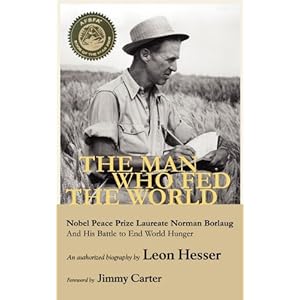
The Man Who Fed the World by Leon Hesser is a biography on the life and work of Norman Borlaug. Borlaug is a Nobel Peace Prize winner and has been credited with saving the lives of over one million people. Borlaug started out struggling with regular academic life, barely graduating high school and nearly not being admitted into college. He attended a small school majoring in agriculture and developed a passion for the industry and helping to feed people. Borlaug is known as, "The Father of the Green Revolution." He earned the Nobel Prize from his work mainly in Mexico where he used beginning forms of biotechnology to create new forms of wheat that were more drought and heat tolerant. I would like to use this book to teach a couple of concepts such as the history of biotechnology, highlighting a leader in agriculture and the essay contest, "Agriculture in a growing world."
Equine Safety by Stephen Mackenzie is a safety manual that tells people from the advanced horseman to the beginner how to properly train and handle horses. Mackenzie breaks down the book into 7 practical applications of how to interact safely with a horse. The overall goal of working with horses is to be safe, always. If not, you will get hurt. The book includes quality pictures and diagrams to illustrate the training and safety. I like the fact this book is very applicable and easily used by students. The book does not have the resources sited and therefore it is difficult if a reader is looking into more information. I also think the text is slightly outdated because the book was written in the 1990's and could be slightly more up to date.
b.) Overall, I think all the books are applicable and readable by students. I would use small portions of each text to teach from instead of assigning the whole book to be read. Thinking in Pictures and Equine Safety could be used in one of my animal science classes when discussing animal handling and animal welfare. Grandin and Borlaug are leaders in the agriculture industry and I would use their two books to teach more about them, their impact on agriculture and the ways they have succeeded past several obstacles.
c.) Reading does not just have to be from a text book. This is one of the biggest shifts in thinking that occurred from this book club discussion. I remember doing some reading in high school but it was all primarily off of the internet or small portions of a textbook. I have seen that books, whether fiction or non-fiction, can be used to teach many concepts in agriculture. It is a little difficult to find books in agriculture but when I do, I would like to use them as higher interest text's than a text book. I would also like to encourage my students to read for their own personal pleasure. I can do so by teaching from the books that are interesting to students and maintaining a classroom library like I came up with to for students to peruse and read in their free time.
d.) In every unit I teach, I plan to incorporate reading to help teach or supplement part of a lesson. I would like to find a list of texts that are interesting to students, easily read and can teach multiple concepts. Some ways I could do this is by reading portions of the text to students and having them analyze the portion, selecting parts of the text for individual reading and also grabbing excerpts from books that students have to look deeper into to understand the meaning of the book. Mixing some of these high interesting books with text books should make students a little more willing to read and help them gain interest in reading for their own interest or pleasure. I know that I cannot make my students read but by incorporating this into the classroom on a regular basis is a good way to increase the reading done by students and hopefully find something that all students could be interested in.

No comments:
Post a Comment