Monday, December 10, 2012

Blog 5

Wow, I have to say that I was a skeptical of the usefulness of this course when I started.  The experience I have had with my other secondary education courses has been less than stellar.  However, this class certainly sets the standard for how useful, positive and productive a teacher education course can be.  I am very happy to have taken this course because it was a similar subject to another secondary education course I took but I feel like this one has given me concrete ideas and methods that I can use while student teaching and in my career. 

To begin with, I have learned that I can and should incorporate some form of reading into every unit I teach.  I can remember reading out of the book as sort of a punishment in high school and I think that has to change with my classes because reading is an important skill for students to develop and use.  In order to help students do this, there are a few things I need to do with every reading lesson.  First, never turn the students loose on the text and just expect them to understand.  I need to do pre-reading activities such as previewing the text and making inferences about what it could mean to get the students thinking then have them actively read with during reading activities.  Lastly, the after reading is most critical to understanding and comprehending a text so I must have the students ask questions, annotate the text or do a graphic organizer, some activity that applies the text to a deeper level.  I want to have a wide variety of texts for students to read because when the text is interesting, students are likely to be more engaged in the reading.

Next, writing is a very important job skill and most students have had bad experiences with writing.  I will do my best to incorporate some form of level one writing into my classes every day.  This is very informal writing and could be anything from filling in guided notes to working on a bell or exit quiz.  The purpose of this writing is just to get students writing down thoughts and ideas and not to be judgmental.  In terms of level two and three writing, these are going to be done less often in my classroom, probably a couple of times a semester.  I really like the level two writing because it allows me to just focus on one or two characteristics and not have to give a lesson on all the characteristics I want to look for in the writing.  In addition, this is going to be the majority of writing students do in a job.  A writing prompt is key to helping students feel like the writing is important and not too restrictive.  Things like making the audience real, giving students a rubric, and keeping the topic broad enough that there can be multiple answers is critical when it comes to writing prompts. 

Third, I have a good understanding of what critical literacy is and what I can do to incorporate it into my classroom without being overly aggressive about it.  In another course I took, we discussed mainly just the philosophy of critical literacy and I never had a good idea of how to incorporate it.  Working with digital text is a great time to work critical literacy into the picture because you can have students question the text, question any biases or sources/lack of, and many digital texts are up to date on social issues that can be talked about.  Critical literacy needs to happen mainly on the part of the students though.  I liked learning about how to make a good discussion, which I think, can happen in many parts of agriculture such as conventional vs. organic, cloning, genetically modified organisms, climate change, and immigrant workers.  Each of these does not have a definite answer, which is important when having a true, honest discussion where students can come up with their own questions on the subject.  Critical literacy fits into many segments of other forms of instruction and I think it is my job as a teacher to teach students to question and not just pass things off as true because someone else said it.

Overall, this course has given me some very good ideas of how to improve the learning of my students.  Reading, writing, using digital texts, helping ELLs, asking students to critically analyze, all these skills will improve my teaching as well as my students experience and learning.  I liked the fact that Amy modeled the lessons for us because it is easy for me to recall those lessons and then adapt it to my content area.  I also know how certain types of activities or lessons should be run and how to get students to the ultimate goal of the activity.  The ball is now in my court.  I know that some of my lesson plans I have created need some work to do all these things I have said I need.  Additionally, I need to constantly remind myself not to use writing or reading something as a punishment because it is very easy to fall into the trap.  Literacy is my job just as much as it is the English teacher’s job.  I have to do my part to be sure students are learning as much as they can and are prepared for a job or continued education when they leave my classroom. 

Sunday, December 9, 2012

Self Selected Project B - Book Club Discussion


Book Club Discussion

Summary of Selected Books.

a.)  Ken Lym, Stephanie Whipple and I each read three different books that we felt could be interesting to students in our field of agriculture education.  I read the book Thinking In Pictures by Temple Grandin.  Dr. Temple Grandin is a world renowned animal science expert who happens to credit much of her success and skill to being autistic.  Thinking in Pictures is a book that discusses Grandin's views on autism, how autism has allowed her to develop her skills and how autism can be helped and encouraged in others. 

To begin with, Temple Grandin talks about how she see's differently than the majority of us.  She see's in pictures.  Even the words she hears are translated into pictures that run in movie format in her head.  This has enabled her to be a very visual thinker and run through possible animal handling facilities through her head before she even writes this down.  At the time the book was written, 1/3 of all cattle in the United States are handled in facilities that Grandin had designed.  I like the fact that this book has the references sited throughout and is not purely opinion based.  I also like the stories Grandin uses to illustrate her points.  Half way along the book, there are a series of pictures that show some of Temple Grandin's drawings and facilities which allow us to see what she is talking about.  The big issue I have with the book is that it is written between an instructional and frustration level for high school students.  There are quite a few scientific words in the text that would be difficult for students to read the book independently.  Additionally, the opinions of Grandin are not very applicable to the content area and therefore I would only have students read certain portions of the text.

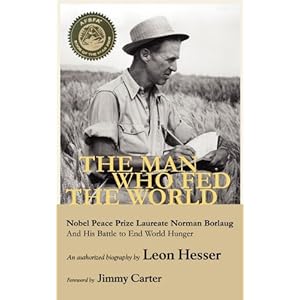
The Man Who Fed the World by Leon Hesser is a biography on the life and work of Norman Borlaug.  Borlaug is a Nobel Peace Prize winner and has been credited with saving the lives of over one million people.  Borlaug started out struggling with regular academic life, barely graduating high school and nearly not being admitted into college.  He attended a small school majoring in agriculture and developed a passion for the industry and helping to feed people.  Borlaug is known as, "The Father of the Green Revolution."  He earned the Nobel Prize from his work mainly in Mexico where he used beginning forms of biotechnology to create new forms of wheat that were more drought and heat tolerant.  I would like to use this book to teach a couple of concepts such as the history of biotechnology, highlighting a leader in agriculture and the essay contest, "Agriculture in a growing world." 

Equine Safety by Stephen Mackenzie is a safety manual that tells people from the advanced horseman to the beginner how to properly train and handle horses.  Mackenzie breaks down the book into 7 practical applications of how to interact safely with a horse.  The overall goal of working with horses is to be safe, always.  If not, you will get hurt.  The book includes quality pictures and diagrams to illustrate the training and safety.  I like the fact this book is very applicable and easily used by students.  The book does not have the resources sited and therefore it is difficult if a reader is looking into more information.  I also think the text is slightly outdated because the book was written in the 1990's and could be slightly more up to date.

b.)  Overall, I think all the books are applicable and readable by students.  I would use small portions of each text to teach from instead of assigning the whole book to be read.  Thinking in Pictures and Equine Safety could be used in one of my animal science classes when discussing animal handling and animal welfare.  Grandin and Borlaug are leaders in the agriculture industry and I would use their two books to teach more about them, their impact on agriculture and the ways they have succeeded past several obstacles. 

c.)  Reading does not just have to be from a text book.  This is one of the biggest shifts in thinking that occurred from this book club discussion.  I remember doing some reading in high school but it was all primarily off of the internet or small portions of a textbook.  I have seen that books, whether fiction or non-fiction, can be used to teach many concepts in agriculture.  It is a little difficult to find books in agriculture but when I do, I would like to use them as higher interest text's than a text book.  I would also like to encourage my students to read for their own personal pleasure.  I can do so by teaching from the books that are interesting to students and maintaining a  classroom library like I came up with to for students to peruse and read in their free time. 

d.)  In every unit I teach, I plan to incorporate reading to help teach or supplement part of a lesson.  I would like to find a list of texts that are interesting to students, easily read and can teach multiple concepts.  Some ways I could  do this is by reading portions of the text to students and having them analyze the portion, selecting parts of the text for individual reading and also grabbing excerpts from books that students have to look deeper into to understand the meaning of the book.  Mixing some of these high interesting books with text books should make students a little more willing to read and help them gain interest in reading for their own interest or pleasure.  I know that I cannot make my students read but by incorporating this into the classroom on a regular basis is a good way to increase the reading done by students and hopefully find something that all students could be interested in.